
First Aid at Work: 1 Day or 3 Days?
What each course actually covers, which workplaces need which, and why the decision comes from your first aid needs assessment rather than your headcount.
Enquire about this training
Tell us what you need and we will come back with dates and a price.
Request a callbackOr call 0845 838 4643
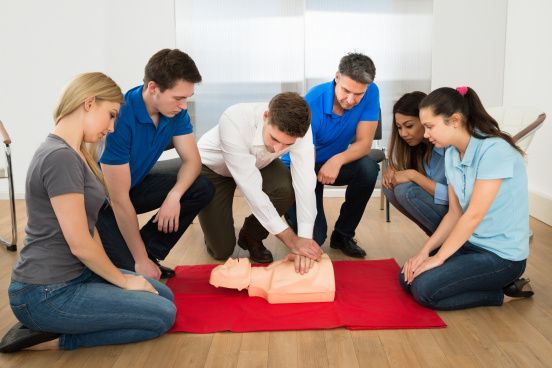
Quick answer
Emergency First Aid at Work (EFAW) is a one-day course covering the immediate life-saving essentials, and is what most lower-hazard workplaces — offices, shops, small professional firms — choose. First Aid at Work (FAW) is three days, covers a much wider range of injuries and illnesses, and is what higher-hazard workplaces such as manufacturing, construction and warehousing usually need. The decision is not made by headcount or by us — it comes out of your first aid needs assessment. Both certificates last three years.
If someone has just handed you responsibility for organising first aid training, this is the first real decision you have to make — and it is the one that most affects both your cost and whether your provision would stand up to scrutiny.
This page covers what separates the two courses, how to work out which one your workplace needs, what each costs to run, and the mistakes that cost employers money.
EFAW vs FAW at a glance
| Emergency First Aid at Work | First Aid at Work | |
|---|---|---|
| Length | 1 day (approx. 6 contact hours) | 3 days (approx. 18 contact hours) |
| Aimed at | Lower-hazard workplaces | Higher-hazard workplaces; lead first aiders anywhere |
| Certificate valid | 3 years | 3 years |
| Renewal route | Repeat the 1-day course | 2-day FAW Requalification, before expiry |
| Assessment | Practical, continuous | Practical, continuous, plus written questions |
| Max learners | 12 | 12 |
| Priced | Per person (open) or per course up to 12 (group) | Per person (open) or per course up to 12 (group) |
| Typical use | Office, retail, salon, professional services, back-up first aiders | Factory, warehouse, construction, engineering, lead first aider |
What each course covers
FAW includes everything in EFAW and then adds. This is the content comparison:
| Topic | EFAW (1 day) | FAW (3 days) |
|---|---|---|
| Role of the first aider; the law relating to first aid | Yes | Yes |
| Assessing an incident safely | Yes | Yes |
| Unresponsive casualty; airway; recovery position | Yes | Yes |
| CPR and use of a defibrillator (AED) | Yes | Yes |
| Choking | Yes | Yes |
| Seizures | Yes | Yes |
| Shock | Yes | Yes |
| Wounds and bleeding | Yes | Yes, plus severe bleeding |
| Minor injuries, burns and scalds | Basic | In depth |
| Fractures and dislocations | — | Yes |
| Head and spinal injuries | — | Yes |
| Chest injuries | — | Yes |
| Heart attack and stroke | — | Yes |
| Asthma, diabetes, epilepsy | — | Yes |
| Anaphylaxis | — | Yes |
| Poisoning | — | Yes |
| Eye injuries | — | Yes |
| Managing an incident; delegating to others | — | Yes |
| Record keeping and reporting | Brief | Yes |
| Extended scenario practice | Limited | Substantial |
The single biggest difference is not the topic list. It is that the extra two days are mostly practice and scenarios rather than lecture. Anyone can learn what a recovery position is in ten minutes; being able to do it calmly, on a real person, with colleagues watching and someone shouting, is a different skill and it only comes from repetition.
Which one does my workplace need?
There is no list that tells you. The Health and Safety (First-Aid) Regulations 1981 require provision that is adequate and appropriate for your circumstances, and you work out what that means by carrying out a first aid needs assessment.
Indicators that point to EFAW
- Office, retail, professional or administrative work
- No machinery beyond normal office or light commercial equipment
- No hazardous substances beyond ordinary cleaning products
- Single floor, or a small building with short internal distances
- Ambulance access is straightforward and response times are normal
- Few or no lone workers, and no significant out-of-hours working
- An accident history dominated by minor cuts, slips and strains
Indicators that point to FAW
- Machinery, power tools, moving vehicles or lifting equipment
- Work at height, in confined spaces, or with electricity
- Hazardous substances, hot surfaces, chemicals, dust or fumes
- A large, spread-out or multi-building site where reaching a casualty takes time
- Remote locations, or poor ambulance access
- Shift work, night work, lone or travelling workers
- An accident history involving crush, cut, burn, fall or eye injuries
- Employees with known health conditions that could produce a medical emergency
Things that do not decide it: how many people you employ, what your competitors do, or what a training provider would prefer to sell you.
For the full method, see how many first aiders does my workplace need?
The mixed approach most employers end up with
In practice, plenty of organisations do not choose one or the other. A common and sensible pattern:
- One or two people on FAW — the lead first aiders, who will take charge of an incident, brief the ambulance crew and manage other helpers.
- The wider group on EFAW — enough people that there is always somebody qualified on site, across every shift and through annual leave.
This usually costs less than putting everyone through three days, and it produces better cover than putting everyone through one day. If you have never looked at it this way, it is worth modelling before your next round of training.
What it costs, and which format is cheaper
Whichever course you pick, the format decides the bill:
| People to train | Usually cheaper | Why |
|---|---|---|
| 1–3 | Open course places | Priced per person; no minimum |
| 4–12 | Group course at your premises | Priced per course, not per head; no travel time lost |
| 12+ | Multiple group courses | 12 is the practical maximum per session |
The hidden cost people forget is time. Three people travelling to a venue for a one-day course is three days of work plus six journeys. The same course delivered on site is three days of work and no journeys — and the scenarios can use your own workplace, equipment and layout, which makes the training measurably more relevant.
Four mistakes that cost money
- Training everyone to FAW “to be safe”. If your assessment says EFAW is appropriate, three days is two days of wasted time per person, every three years.
- Training only one person. One first aider is not cover. They take leave, they get ill, they leave the company. Two is the practical minimum almost anywhere.
- Letting a FAW certificate lapse. The two-day requalification route is for renewing a current certificate. Once it has expired, you may be paying for three days instead of two. See how long does a first aid certificate last?
- Never writing the assessment down. HSE does not require you to record it, but without it you cannot show why you chose what you chose — and that is the question that gets asked after something has gone wrong.
What about paediatric and mental health?
- Nurseries, schools and childcare need Paediatric First Aid, not EFAW or FAW. The techniques for infants and children genuinely differ — the choking sequence, the CPR ratios, the conditions you are looking for. Early years settings in England also have their own requirements under the Department for Education’s EYFS statutory framework.
- Mental Health First Aid is a separate thing again and is not required by the first aid regulations — see is mental health first aid a legal requirement?
- Defibrillators. Both courses cover AED use. If you have an AED on site, the training is the easy part — the harder part is making sure everyone knows where it is and that its pads and battery are in date.
Book a course
Deals
First Aid at Work Courses
 Emergency First Aid at Work Group Course
£495.00 Excluding Vat
View course →
 Emergency First Aid Open Course
£85.00 Excluding Vat
View course →
 First Aid at Work Group Course
Price range: £945.00 through £1,145.00 Excluding Vat
View course →
 First Aid at Work Open Course
£165.00 Excluding Vat
View course →
First Aid at Work ReQual Open Course
£95.00 Excluding Vat
View course →
 Paediatric First Aid Group Course
Price range: £650.00 through £750.00 Excluding Vat
View course →
 Paediatric First Aid Open Course
£105.00 Excluding Vat
View course →
For the wider picture — what the law requires, the minimum every employer must have, how many first aiders, which course, certificates and the 2024 changes to HSE’s guidance — see our guide to workplace first aid requirements.
Frequently asked questions
Emergency First Aid at Work is a one-day course covering the immediate life-saving essentials — unresponsive casualty, CPR and defibrillator, choking, bleeding, shock and seizures. First Aid at Work is three days and adds fractures, head and spinal injuries, chest injuries, heart attack, stroke, asthma, diabetes, epilepsy, anaphylaxis, poisoning and eye injuries, with far more scenario practice. FAW includes everything in EFAW.What is the difference between EFAW and FAW?
For many lower-hazard workplaces, yes — that is exactly what EFAW is designed for. Higher-hazard workplaces normally need the three-day FAW course. Your own first aid needs assessment decides it, based on the hazards present rather than the size of the business.Is a one-day first aid course enough?
Yes. First Aid at Work is a standalone three-day course that includes the emergency content. There is no requirement to complete EFAW beforehand.Can I do FAW without doing EFAW first?
Three years for both. FAW is renewed with a two-day requalification course completed before the existing certificate expires; EFAW is renewed by repeating the one-day course.How long do EFAW and FAW certificates last?
In most cases we would suggest yes, even in a lower-hazard workplace. The lead first aider is the person who takes charge of an incident, delegates to other helpers and hands over to the ambulance crew — and that is precisely what the extra two days cover.Should our lead first aider do the three-day course?
Plenty of employers do this: FAW for one or two lead first aiders, EFAW for the wider group so there is always cover across shifts and during leave. It is often the most cost-effective way to get genuine coverage rather than a certificate count.Do we need a mix of both courses?
Twelve is the standard maximum for practical workplace first aid. Beyond that there is not enough hands-on time per learner for the practical assessment to mean much.How many people can attend one course?
EFAW is cheaper per person because it is one day rather than three. But the right comparison is against your needs assessment, not against price — under-training a higher-hazard workplace is not a saving. Where cost is the deciding factor, the bigger lever is usually group versus open delivery rather than course length.Is EFAW or FAW cheaper overall?
Still not sure?
Both sit in our first aid at work course range, and how much does first aid training cost sets out how they are priced. Tell us what your workplace does, what equipment is on site and how many people need training, and we will tell you which course is proportionate — including when the answer is the cheaper one. Call 0845 838 4643 or use the enquiry form on this page, and see our open courses across Manchester, Wigan and Bolton.
Book this training for your team
On-site anywhere in the UK, open courses, or online — accredited and delivered by experienced trainers.